Tuesday, 11 June 2013

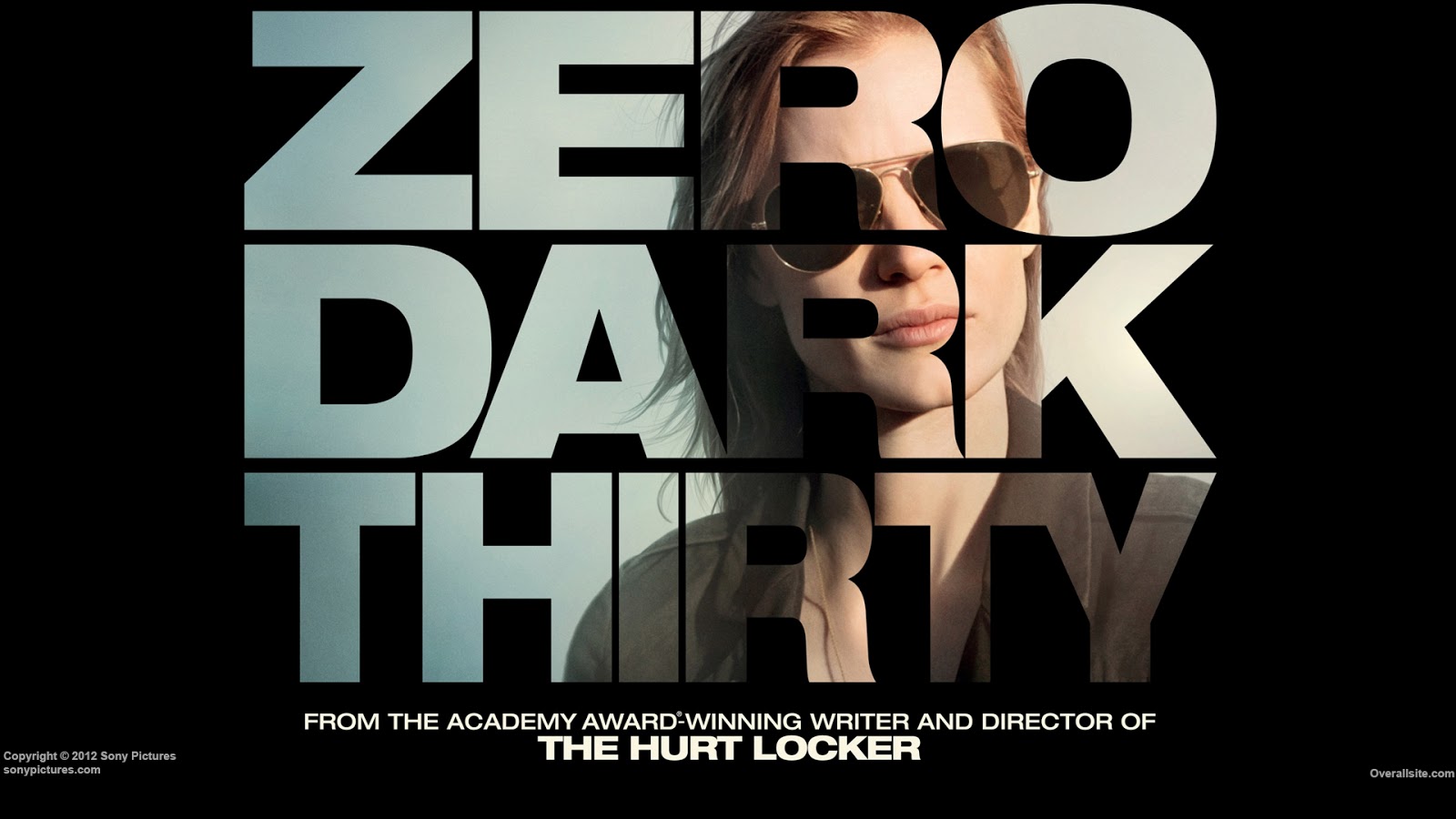
My bit overdue review of Zero Dark Thirty

Zero Dark Thirty is another war-related film from the Oscar-celebrated collaboration of Kathryn Bigelow (director) and Mark Boal (writer). Their second film is dedicated to the ten years of secret operation by an elite team whose only mission is to find and eliminate Osama bin Laden.

As in their previous film, The Hurt Locker, Bigelow and Boal present this war topic with great realism and through non-judging position. Like in The Hurt Locker, the film follows the story through the eyes of a lonely main character dedicated to her mission and work - CIA operative Maya (Jessica Chastain). Not only Maya’s obsession of finding al-Qaeda terrorist leader leads the team of what seems like tired and lost team of intelligence, it also drives the whole film. Considering that Jessica Chastain’s character is a woman without secrets, interesting stories or personal problems, it seems at first as an impossible task to get a real hero out of Maya, but Jessica Chastain does it brilliantly with her pure and sincere performance. The actress proves that she is gifted not only in the comedy roles like in The Help or supporting roles like in Lawless and Coriolanus but also as a lead in a serious drama.

Dramatically a lot of focus and attention concentrates on a character who becomes a center of the film, a real person who is the only reason of the story’s existence - the leader of al-Qaeda. He is an invisible villain. A goal of creating drama through fighting an invisible villain is a difficult task in filmmaking and that is where “Zero Dark Thirty” lacks its visual expression.

Zero Dark Thirty does not feel like a long film (despite its 2 hours 37 min) but its broken pace damages everything: years pass by in a repetition very quickly while the raid itself is shot almost in a real-time, minute-by-minute speed.

Kathryn Bigelow and Mark Boal made an important creative decision not to commit to any viewpoint and decided to follow passionate but quite straightforward character. All these decisions left this film emotionally cold and very “as a matter-of-fact”.  

The manhunt for one of the world's most dangerous man is a tremendously important event in the history of the 21st century and no wonder that it attracted one of the best filmmakers of our time. However in the attempt to show a true event without slipping into a melodrama of a patriotic victory and avoiding factual problems, the filmmakers showed an unemotional story of a lonely individual on the edge of the earth trying to achieve her goal for no apparent personal reasons. As a story it is amazing and by no means important in the history of 21st century, but the decisions made in the script almost diminish its value and as a film it fails to impress.


Sunday, 9 June 2013

Sweetheart is up online

It's been a year and couple of months since we shot short film Sweetheart in West London.

Since then Sweetheart, written by talented Lisa Gifford and produced by super-competent Elisar Cabrera, enjoyed a great festival run with a Premier screening in London at Raindance film festival, screenings at Bragacine Fim Festival in Portugal and two festival in the US: West Chester Film Festival and Fort Lauderdale.

It feels like it's been such a long time ago since we wrapped filming on the day, and to be honest the shoot went so smooth that I was waiting for something to go wrong. Luckily it didn't, thanks to our amazing crew and everyone who helped out it was a very pleasant experience.

Here is a full film online, if you like it, please do share and click on "like" on youtube page.


I hope this is my first amongst many future joint projects with the lovely team behind Sweetheart.


Friday, 7 June 2013

Summer, friends

Summer rainy days.
I am sitting in between.
In the middle of life,
Staring outside
Water falling down.
In the middle of life,
Right here, right now.

I don't want anything.
It's not about basic needs and secret desires or love in general.
Love is about freedom, and I let everyone go.
Some stayed for some time, some didn't.

Some are still here, at the back of my mind and at the reach of a phone button, ready to help, to talk, to laugh or just there.
In them I trust. In their existence.
They do not need to prove themselves every time to me.

I'll even forgive them if they are late.
Although they can't be late.
Because they are never truly gone.


Wednesday, 12 December 2012

Film of The Day - 12.12.12

I decided to make a post every day on a film that reminds me of the events happening today or something related to my experience of the day. This is to do with one of my resolutions which I am starting today rather than on Monday or in New Year - a resolution to write a blogpost every day.

Today the Russian President Vladimir Putin gave his usual annual speech to the nation. It was broadcast live from the hall of Sover Federacii where the rest of the Parlament was listening to his speech.

I am not going to go on how many of things he said were true and how many were lies, and how his viewpoints are different from his actions. Actually, the last one is relevant.

Being a politician at the top, one learns how to reason and justify their actions even when they feel those actions are wrong. We don't know what actually Putin thinks and maybe he doesn't even justify the reasons for his idea of treating the Constitution the way he wants and allow such a serious miscalculation in election votes to make him President for two more times.

I want to remember of another politician today and the way he faced truth after he was retired. Those historic events were captured in the film Frost/Nixon (2008).

This film gives us a great way to understand the way people at the top make decisions. The drama of that interview being broadcast live to the whole nation, brings the sense of "immediate" sharing.

This film makes me think of what would happen if right now, while Putin speaks live, something happens and he says something completely truthful and new. But this is not an interview and there is no one to challenge him.

Here is trailer to Frost/Nixon, if you haven't seen it yet, watch it. Maybe next time you see a live broadcast - maybe it's another historic event taking place.


Monday, 19 November 2012

The Whole Era of Soviet Sci Fi is Over...

...as Boris Strugatsky died today.

Part of Strugatsky brothers tandem, he was one of the most influential sci-fi writers not only in the USSR but in the whole world. Born to the society fascinated with space he and his brother also touched on the Soviet and universal problems through philosophical prism.

His works can be known to you through the film of Andrei Tarkovky's Stalker.

But their sci-fi books are so fantastic that they deserve more and more films to be made.

Rest in Peace, Boris.


Wednesday, 10 October 2012

Sweetheart had Raindance Worldwide Premier!

Last Sunday our film Sweetheart that I directed, had its premier at Raindance Film Festival. Sweetheart was screened alongside other short films in the selection of Program 14 named "Thrillers".

The atmosphere at the festival was amazing, previously several days before the screening all the tickets were sold out so the organisers moved this selection to a bigger screening in Apollo Cinema. But couple of hours before the program started all tickets were sold out again. It was packe! People were queuing up to find seats. Every film was welcomed with a round of applauses.

Before the program started filmmakers could introduce the film and say couple of words to the audience:


Huge thanks to all the crew and cast who worked so hard on this film!

We shot film at the end of March 2012 and through making this film I met so many great people!


Here is a picture of the team at the Raindance:


You can read more about the film, its team, news and watch the trailer on Sweetheart's Website.
Also follow Sweetheart on twitter and facebook.


Monday, 1 October 2012

Lawless - my very informal view


Lawless is a new gangster-drama by Joan Hillcoat, director most known for The Road and The Proposition and his collaboration with Nick Cave.

Nick Cave wrote a script for this one as well - this time adapting Matt Bondurant's novel.

I haven't read the novel and these kind of films are usually not my cup of tea unless they are more about the drama rather than the time.

Reasons are, well, half of the time it is hard to understand what they are saying. And it's not just me being foreign and stuff. A lot of British people I talked to could not understand completely, of course they did, but not entirely.

Another reason - not being a person who grew up with the notion of this Prohibition era I can hardly sympathise it. When people were starving in the other countries it is hard to think about poor people not having alcohol and it just feels that like everyone was a baddy those times. The trick is to show that they are baddies with a human face or with very strong dramatic reasons for being baddies. Boardwalk Empire really succeeds with that. And Broadwalk Empre creates characters not out of the blew, of course it has hours and hours to show exposition. A feature-length film does not have this luxury and needs to dig into the story.

But still, a lot of the characters in the Lawless I am left not connecting too. Take the "villain" Guy Pearce. Why on earth is he so weird and so violent? What is it in for him? Why is he so persistent. The greatest way was to show that something bad happened to him or that he actually has his truth. But just being the force of evil is not enough. Besides he is not evil if you think of it - they are breaking the law, and he is enforcing it. In terms of a soldier mind, or a perfect cop or samurai - serving the law or master is matters of pride and dignity. In this case Guy Pearce's character's master is the government.

I am sure there are all these reasons in the book. But I found it difficult following it in the film and sympathising characters.

Acting-wise, everyone was amazing. The way the move, talk, creating the reality in the voice, smiles. From little performances of the Cricket guy to stunning Jessica Chastain and super-sincere performance by Shea LaBeouf. I am not going to talk about Tom Hardy. He is one of the best actors in his generation and I hope he is going to take up more roles like this, central and creating reality from scratch.

Technically-wise, it was beautifully shot and edited, great blocking and compositions. I had some problems with cutting in terms of continuity of movements. It was a stylistic choice but at some points it was taking me out of story. But who cares.

My favourite film of John Hillcoat is the The Raod and this hasn't changed after Lawless came out.


- Posted using BlogPress from my iPad

Thursday, 27 September 2012

We are at Raindance!


Last night one of the most important independent film festivals in Europe - Raindance opened its doors for the 20th time.

I remember several years ago someone recommended me Raindance as great evening course for screenwriting. It was the first step in my filmmaking career (which only just began). I remember the thrill of getting to the course in the evening in Apollo cinema and then hours of talking to fellow film-inspired folks in the local bar.

Two years later and our film is in the festival. Short film Sweetheart that I directed this spring is in the official selection of Raindance in program 14 to be screened in Apollo theater on October the 7th at 17.00. You can view details and book tickets here.

It's been a great year so far for Sweetheart and we are really excited about the future of this film.

Here is a trailer to the short film:

Sunday, 4 December 2011

"My Week With Marilyn" review or "Why did they even bother getting great actors?"


It's 1956 and Hollywood goddess Marilyn Monroe arrives to London to work with famous Laurence Olivier in his film "Prince and The Showgirl". Young and passionate about films Colin Clark uses his connections and dedication to get a 3rd assistant director role on the set of Olivier's film. He observes working relationships on set and starts his own close relationships, including one with Marilyn Monroe.


Michelle Williams plays Monroe and while she does it with charm and delicacy, let's just say truth: she is not Marilyn and one can only pity an actress who has to portrait on screen someone as charismatic as her. Same goes to Laurence Olivier played by Kenneth Branagh. If you want to imagine how these two would go on, it's enough to watch the real "Prince and The Showgirl" and picture Monroe and Olivier playing a Director versus Star. I am not going to criticise Williams' performance as she had to keep up with some astonishingly cheesy lines.

Cheesy lines, that's what downgrades Eddie Redmayne's otherwise brilliant performance. He is usually great with being extremely innocent and sweet, that's what makes him the best for this role and casting couldn't make a better choice for Colin Clarke's character. But saying out loud what belongs to romantic novellas and girls' diaries does not make one look very convincing.

While story is beautiful and sweet, it lacks conflict and scriptwriters failed to dramatise it. Instead they injected a full amount of super-sweet lines in places where silence, a look and a pause on actors' eyes would do a better job. Why cast great actors anyway if you make them narrate all of their feelings? Actors are there to get those feelings out on screen so the audience trust what they SEE not HEAR.

This is what cinema is about.

It's about reaction, when one character is on the front and talks to someone who is standing behind, sometimes reaction is more important than words. But director Simon Curtis decided to go on a narrow lens to make every shot stylish and "cinematic", i.e. using shallow depth of field. It is very frustrating when one can't see a face of an actor/actress just because they are out of focus for stylistic reasons. Why do you need these great actors at all if you keep on not showing their faces?

The middle part of the film was quite flat and repetitive. Shot as a beautiful postcard of Britain it lacks the bittersweet feelings of young Colin Clark. Great sunny weather only suggests that everything is brilliant, while Colin knew at the bottom of his heart it's just a silver lining in the enormous black cloud that covered Marilyn's life.

It is a great film to watch for aspiring filmmakers to see what could be done better at scriptwriting stage, editing and directing. This story could have been saved and had all the potential for being one of the best films this year, Mr Weinstein.


Monday, 21 November 2011

Grading Digital

Hello everyone,

As some of you know I am a filmmaker and currently studying at Metfilm School in Ealing Studios.

Anyway, until now I was only editing and never had a chance to grade or colour correct, now I am in editing class having to grade one third part of a feature film. We are mostly using Colorista II in Final Cut Pro, as it's most suitable for the quality of digital footage we have.

Just wanted to show you a quick example from a first day - I was trying to create an effect of Sepia for one of the flashbacks to 1942.

Here is an original footage:

And here is the changes I applied in Colorista II playing with colours:


To be honest this pictures reduce quality significantly, but you can see the idea behind it.

Have a nice week!

Wednesday, 19 October 2011

A bit of analysis on Czech hidden gem "Daisies"


Film “Daisies” by Vera Chytilova was made in Czechoslovakia in the times of oppression and strong political control of communist party over all the form of art. Vera Chytilova and other brilliant Czech filmmakers (like Milos Forman and Ivan Passer) contributed to the creation of movement that was later called as “Czech New Wave”.

The objective of making film for them was “to make the Czech people collectively aware that they are participants in a system of oppression and incompetence which had brutalized them.” Most films of Czech New Wave including “Daisies” were made just few years before the events of Prague Spring, period of political liberalization at the end of 1960-s in Czechoslovakia.

When analyzing this film it is important to look at the historical, social and cultural context of the times and place where this film was made. “Daisies” is enjoyable to watch and anyone who ever had to deal with any form of repression can relate to this film. “Daisies” is a filmic fest of freedom and joy of rebellion. Somewhat surrealistic it is explained not only by the cultural context but also the social and political setting in which this film was created. Surrealism of this film is an antidote to brutal realism of Soviet and communist societies.

“Daisies” is a great example of anti-narrative structure, made in the years of political, social and cultural oppression it breaks the rules of narrative and style. It is not simply an example of anti-narrative art, it is in every form an attempt of deconstruction of narration. This film despite its illogical structure and form makes an enjoyable and intelligent viewing experience, because the absence of plot is compensated by creation of story (“fabula”) by each individual viewer.

Some parts of “Daisies” include dialogue, but those that do not are in a way similar to silent movies.Soundtrack is mostly illogical and non-diegetic. Some of the scenes are especially similar to the early silent comedies from the use of filmic style: the scene in the night club where girls outperform dancers and show outrageous and silly behavior. First of all there is no dialogue in this scene, only music accompanying it. The place where girls sit looks like a static. Exaggerated movements and gags are great example of early comedies, when cinema was not regarded as a form of art but a form of entertainment.

This is again a revolutionary act from the authors of the film, as in communist societies, film could not be the form of entertainment and pleasure, but the form of education and propaganda.

The absence of constructed dialogue plays an important role in destroying the narration. Rudolf Arnheim argues that “The addition of spoken dialogue has made storytelling easier, dialogue narrows the world of film.”

The context of this film is linked to its filmic style: it is illogical and inconsistent. Any filmic style created is destroyed within some moments. For example, the change of colours with the rhythmic repetition is linked to the change of sound and when audience gets used to it and regards it as the filmic form, just in few moments it is broken only to be replaced by another one. Therefore I believe that the context of this film and the destruction of narration is closely linked to the destruction of filmic style.

Abundancy in food is mirrored in abundancy in filmic construction (although in this case I mean deconstruction): bold cuts, very bright colours, great variety of various cuts, psychedelic visuals , especially the ones with moving train and of course the great number of montage pictures of various things from roses to butterflies.

Film “Daisies” is full of images and actions that can be regarded as archetypes. Carl Gustav Jung described archetypes as “inborn tendencies which shape the human behavior”. These visions and symbols are universal. Jung continues “we often meet these themes in the fantasies, dreams, delirious ideas and illusions". As film in question is following deconstruction of narration and plot , the experience of watching it is very similar to fantasy or a surreal dream. This dream is full of archetypes: a tree of life, virginity, apples (and food in general) as a source of knowledge and life. And of course archetypical fears like castration (cutting phallic-shape food with scissors proceeding to cutting own bodies) and drowning as a form of punishment.  (http://www.carl-jung.net/archetypes.html, 2010).

By including archetypes Chytilova made the experience of watching this film more surreal and dream-like and as any dreams are very deconstructed and illogical. Usually in the morning we do not remember the plot of the dream however we strongly remember the feeling of it.

However one should make a difference between archetypes and stereotypes. While archetypes are included in the convention of the film, stereotypes are destroyed. It is interesting to compare “Daisies” to another very feminine film that deals with stereotypes, “Gentlemen prefer blondes”. The American film does not deconstruct stereotypes but acknowledges their role in society. For example Lorelei says: “Don't you know that a man being rich is like a girl being pretty? You wouldn't marry a girl just because she's pretty, but my goodness, doesn't it help?” (Gentlemen prefer blondes, 1953).

In contrast to that Chytilova destroys every stereotype and “heroines rebelliously try to subvert the patriarchal system and gender stereotypes”. The revolutionary act of sabotaging gender stereotypes goes in harmony with the filmic style of deconstruction. (Kinoeye, 2002).

A great example of illogical narration within the film is a philosophical question (although in the film it is a trivial problem): “Why do they say “I love you”? Why don’t they say, for example “egg”?” Main characters question the meaning of the words that are used everyday with no real meaning and value to it. If they are used with no meaning, why not replace it with something else. The whole film exploits this idea and replaces values and meanings with very brief creation of new meanings and style only for them to be deconstructed in next to no time.

There are different approaches to the principles of film narration. The distinction between the story and the form was theorized by the Russian Formalists. They studied two most important principles: story (also called fabula) and plot (syuzhet).  The plot is “a system because it arranges components – the story events and states of affairs – according to specific principles”. And there are three sorts of principles that relate plot to the story: Narrative Logic, Time and Space. Chytilova does not follow these principles in “Daisies”, the flow of story is illogical, time does not matter and space is a free structure.

Story or fabula on the other hand is not a system, it is action, series of events. Tynianov argues that “story can only be guessed, it is not a given”. (David Bordwell, 2005).

At the very beginning of the film Marie I says “Nobody understands anything”, this  is a great summary to the plot of the film: it warns audience that there is nothing to understand and every attempts to find meaning and matter will be laughed at and destroyed within no time. (Daisies, 1966).

Narration structure was viewed as one of the most important elements in creating film and plot. But experimental filmmakers had a fresh approach to filmmaking by using anti-narrative. Anti-narrative on its own has got a structure and follows its own rules created by authors within the film. But “Daisies” is a great example of early experimental films which destroy any attempt to find logical plot. Any new form of narration and style to be regarded as new shall be first deconstructed and broken.

At the end of the film when girls are drowning, film questions: “Is there any way to mend what’s been destroyed”. The answer is no, as girls are killed with a huge chandelier and the film is ended with no chance to mend its deconstruction. (Daisies, 1966).
This was followed not only in art but also in society: revolutions were needed to create a new society. It is a pity that it took Czech Republic and its filmmakers such a long time before revolution and the chance to create openly.


Bibliography.

Bordwell, D. Principles of Fim Narration. In: Wartenberg, T.E., Curran, A. eds. The Philosophy of Film, 2005, Oxford: Blakwell Publishing Ltd.

Concept of Archetypes at Carl Jung, 2010. Carl Jung Resources, [online]. Available at: http://www.carl-jung.net/archetypes.html

Daisies (Sedmikrásky), Vera Chytilová, 1966, Czechoslovakia.

Gentlemen prefer blondes, Howard Hawks, 1953, USA.

Hames, P., The Czechoslovak New Wave, 1985, Los Angeles: Berkeley.

Radkiewicz, M., 2002. Angry Young Girls. Kinoeye, 2(8).

Tuesday, 13 September 2011

Chess is a pure drama

Sometimes as filmmakers we are looking for new fields of drama for ideas for films. Court and medicine are the best examples of pure drama where life and death and other values like justice are at stake. That explains the popularity of courtroom series and hospital tv series.

But sometimes drama lies in the things that we usually regard as boring. Chess is a great example of a dramatic sport where personalities and different temperaments crash and collide.

A new film "Bobby Fischer Against the World" distributed by DogWoof, proves that chess is a great source of drama with great and weird genius at war, like Bobby Fischer himself. This is the first documentary to explore the bizarre life of one of the greatest chess players, Bobby Fischer.

You can watch the preview or the whole film here

Wednesday, 7 September 2011

Michael Schumacher. Brilliant 20 years.

The other day I was talking to the priest in Orthodox church as part of my "Leto Be" documentary about the fans of 30secondstomars, Echelon. So I was asking him about the lines in Bible that say that one shall not make yourself an idol in the form of of anything. The truth is that I always had idols in life, they helped me to be who I am.

One of them, the first of them is Michael Schumacher.

He is an unwritten book. He is a warrior in shining arms of nowadays. His poster that I had since I was 15, helped me to believe in myself and to fight till the end. Whether you are at the exam and feel like you lost it all, or in your relationship. He was always fighting till the end even when it was illogical to continue. The most logical driver used his intuition when it mattered the most.


And sometimes he was totally wrong. I admire him for his mistakes more then for his championships. Not that I approve of them and I am glad he acknowledged and apologised and learnt a big deal from them. He didn't give up.

It is very easy to take your mistake of one moment, one wrong choice you did and guide your whole life as a misery and blame yourself and have this eternal excuse of being a wrong-doer. It takes far more courage and inner strength to stand up as if you are a new person with a blank history and go on. It is much easier to be unhappy then happy and brilliant.

Michael Schumacher is not brilliant because he's born brilliant. He is brilliant because he chose to be brilliant. And that choice is a choice of a true hero. Whether it means tragic hero one day, like in Adelaide, or a perfect hero like in Japan (choose your favourite year).

My admiration of him wasn't always consistent. I cried my eyes out when he broke his leg. And his decision of come-back made me cry too, in a good way. But then for numerous races I was questioning his decision and choice to be back. Until I realised again, that he is being himself, not an idol, a real person who makes illogical choices because he believes in them. And he might be wrong sometimes. But yet again, he will never have regrets, that he didn't try.

He is racing for 20 years because he cannot not to race and there is no ego anymore involved in this process. He is doing it because he can and he wants to. I admire this even more then some of his greatest victories. He reached the state of not caring when he cares. It's hard to explain but I guess that's what they call wisdom and I hope that one day I will reach it too. And when I do, I will look back at my most embarrassing moments in life and acknowledge them and be thankful to Michael Schumacher for teaching me not to give up and get pass your own selfish guilt.

Last race (Spa 2011) was amazing and British media and fans all worshipped Button who came third from 13th. But the man who was 5th came from the last place on grid, he overtook 19 cars. He didn't win. Neither did Button. But we know that those two really are true warriors.

I have no vocabulary to express my feelings to Michael!!!

To prove he is not an idol but a human being here is a press-conference of him at Monza when he cried.


Picture taking from F1Racing Facebook page, September issue of F1Racing magazine. 


Friday, 2 September 2011

My Short Observational documentary "Two More Sausages"

As some of you know I am co-producing a feature documentary happening in Bosnia "My Side Of School". Director Chris Bates is leaving today for the first trip of shooting today so wish him luck. With your help and support of our friends and relatives we raised $4000 for the first art of the documentary. Check out the fund-raising trailer here http://www.youtube.com/watch?v=ki1zYr3k1Dw&feature=player_embedded


But as a director of documentaries I am very novice, so here is my first very short observational documentary on one day of a local coffeeshop "Two More Sausages". The criteria for this doc was to shoot without words, so no interviewing and not interfering the process and life. This is as part of my documentary module at MetFilm School.

As my tutor, Caroline Deeds, director of some BBC and Channel 4 docs, always says, patience is very important for any documentary-maker. And it was certainly true in case of shooting "Two More Sausages". A 3 hours wait was worth it as a very interesting client appeared in the cofeeshop...


Please let me know what you think and how it can be made better, your advice is very important for me.


Friday, 26 August 2011

Licensed Web Series

During two months of this summer I was working on the webseries called "Licensed" as a producer. These are webseries about Raymond Hewitt, a TV Licensing detective enforcement officer. His sole mission in life is to find all those who have failed to pay for their TV Licences and punish them. He will do so in style.

The production of series was a great pleasure and surely a lot of hard work. It was a great experience and I shall take some time one day to share with you my idea of making webseries on low budget.

Here is a 4th episode of Licensed, where Raymond Hewitt visits a student house...

If you like the series, subscribe to us on youtube http://www.youtube.com/user/LicensedProductions


Tuesday, 9 August 2011

My Side Of School - Crowdfunding campaign

I have been quiet on this blog for a while, please forgive me for such a long silence. I was going to create a new blog but then decided that this one has too many things I value.

I am co-producing a feature documentary called "My Side Of School".

My Side of School' will be an observational documentary about the division between young and old in the small town of Stolac in Bosnia & Herzegovina. There is already division in Stolac - the population of Bosniaks (Muslim) and Croats (Catholic) has endured nationalist rule since the end of the war in the 90s, and local politics aims to keep the two groups apart.

Most young people do not mix with those from the other group, drinking coffee in their own cafes.
However Edvin, Nives and friends are unconventional in that they are a group from both backgrounds.

These characters find it hard to spend time together, especially during the week, as the school they all attend keeps the two ethnicities apart: Croats attend in the morning, and Bosniaks in the afternoon.
Separate sets of staff teach them their own languages and their own versions of history.

This division is clear in the open, but away from the public eye, it's a different story.

There is a hotel in the centre of town which has been decaying since it was burnt out during the war.
Nives and her friend Zora joke that it's now alive again - its dark rooms are the perfect place for clandestine, cross-ethnic teenage adventures.
If their parents knew they were romantically involved with Muslim boys, there would be hell to pay.

This feature-length observational documentary will follow these and other characters over 12 months, to provide a picture of young love, ambition versus apathy, and the conflict between religion, politics and identity in a country that is struggling to prepare itself for the future.


We are funding the next trip to Bosnia via crowdfunding on the website called Indiegogo. For as little as $5 you can be involved in making this documentary and be part of this project.


Sunday, 10 July 2011

Dream Journal - death of a cowboy

July 9 - crime scene
This dream was again without my presence and not about me. I was a constructor of a dream, I was a director looking through the camera display, a writer putting the words in the mouth of a man.
This man, a cow-boy looking old man with grey hair but yrt black moustache, was shot in two places. His first thought was how is it fair, but it soon passed away necause a sharp wave of pain hit his brain and soul. He thought for a moment that he can trick death yet again. He covered the wound with his hand and on camera he was alive. But he was dying in a movie, and for him - both an actor and character it was a point of no return. 
He died in my dream, he died in a movie, but that image of an old hand covering wound is still there.

The Undiscovered Self

Wednesday, 5 January 2011

Film Releases in 2011

My friends from FirstShowing.Net created a wonderful list of film releases in 2011 (US dates).

This list should be as usual divided into the Pre-Oscar season untill March and Post-Oscar season.

January is full of funny blockbusters and comedies with the highlight of beloved "Green Hornet".

Not so many big names are released in February as companies will be busy with the awards season.

March comes back to screens with several interesting-looking thrillers: The Adjustment Bureau, Limitless and The Lincoln Lawyer.

April looks interesting as it highlites the release of comedy "Your Highness", a detective action film "Hanna" and circus drama "Water for Elephants".

May is definately a big month for blockbusters: Hangover part 2, Thor, Pirates of the Caribbean: On Stranger Tides, Kung Fu Panda: The Kaboom of Doom. Another film that is coming out in May is the film I am most looking forward to "The Tree of Life" starring Sean Penn and Brad Pitt.

Summer brings us a great number of summer actions flicks like Green Lantern, X-Men, Cars 2, Transformers: Dark of the Moon, Captain America: The First Avenger, Cowboys & Aliens and the final part of Harry Potter.

Tuesday, 4 January 2011

Democracy in Russia is less than a word

Can you imaine spending New Year's Eve and Christmas in prison? for 15 days? in the 3 meters square room with no window, no bed or charis, just walls. Can you imgaine that you are a world-wide well-known politician who can't spend holidays at home because you were arrested at the political demonstration which was legally authorised by police and local authorities?

If you can't imagine those things happening you clearly are not from Russia, for in modern Russia human rights and government do not go along.
Source: www.echo.msk.ru


On the 31st of December 2010, the former deputy prime minister and opposition leader Boris Nemtsov was arrested after political demonstration for "failing to follow police instructions". He was arrested after the demonstration that is held every 31st and 30st of the month to support the 31st article of Russian Constitution which states that every citizen has gor a freedom of speech. This human right is one of the basic rights in democratic countries, however it is contantly violated in Russia and the latest events proved it. The opposition has obtained a permission to hold this demonstration, so police arrested Nemtsov and other demonstraters after the event was over on their way home for not obeying police instructions. Those who were at the event say that there were indeed some anti-Putin and anti-government discussions at the demonstration.

Source: www.echo.msk.ru

This event was not covered on any of the TV channels in news. Most of the country who does not have access to internet does not know what is going on with the government opposition.

The court decided to give 15 days of imprisonment to Boris Nemtsov. For what? for merely questioning the work of Russian government. Considering that upcoming government elections will probably have the same level of equality we have no prospects in near future for the change of course.

Here is a link to this news on BBC news.

Politics of Russia (6th Edition)

Russia and the Russians: A History

Saturday, 17 July 2010

To the people of the Twenty First Century

We are given with tools, knowledge and freedom to build the new house of humanity. But standing here with spade in our hands, how can we be sure that we are building a basement - not a graveyard. And yes, we are children of our parents, whose blood and soul were tortured by the inhuman kinds of the 20th century. For more then 100 years they learnt to be brave and oh not so vulnerable. What can we rely on if church is no longer united, there are no souls left in the parents' house or the library - where shall we take the inspiration to restore nature and house?

Earth... First we need to get strength, we need to get rid of thirsty feeling and get back to job, and we are the diggers, graving the past and mourning about it, even though we didn't do it. We are here because someone else didn't do it either - in the 20th century of inhuman kinds there was place for humans, we are here because of them. How many are not. We are diggers, our ignorance and inner conflict take us down, standing on our knees, doubts like worms eating us from inside. Our elder brothers and sisters lost themselves in the agonizing freedom and oblivion of drugs, sex and videogames. We can't count on them, can't look up to them. Their dreams are dead and Requiem is conducted.

Digging is not an honorable job, not at all. Each of us asks question: why on earth do I have to do it? I didn't do anything wrong, it's all because of those generations before me, leave me alone, people, all I want to do is sit back and enjoy life, if stupid Paris Hilton does that, why can't I do it?"
I know life is unfair. But I guess each generation as each person has got its mission, its pre-destination. Isn't our mission now to save earth and to show next generations how it's done? Wouldn't it be a great example for our children how to treat nature? Maybe they'll call us "the people who saved us"; maybe they'll make movies about us? Maybe the house on the basement that we first destroy and then build again - maybe it'll be a brilliant example of architecture, a piece of art, a masterpiece. Can they count on us? Those future generations, those unborn kids. Will they praise our Requiem for a Dream? Or will they just acknowledge "Glamour life and no dreams"?

Sitting here at 2 am in the morning and burning energy on this PC, I am asking whether I am any better, whether I am brave enough to start digging the basement, no glamour dress, but gloves to clean oil from birds. Is this a dress code for the 21st century? Or is it just another costume party?
I am not saying that we have to sacrifice ourselves. But let's start thinking! Reflect!

We are the awareness. We are the start of today. We are the fresh green grass outside of OUR house. We are the faces on google map. We are switched off lights. We are saved tuna dolphins. We are windmills. We are the beauty of unspoiled sea. We are the sustainable farms. We are the wind. We are the people of the 21st century.

Let our children be proud. I am not saying - sacrifice yourself. I'm saying - SWTICH ON YOUR MIND.

Next time you are switching on lights in several rooms - switch on your mind.
Next time you are taking plastic bag in the supermarket - switch on your mind.
Next time you print stupid emails - switch on your mind.
Next time you use your car - switch on your mind - maybe there's a bus or a bike.
Next time you are washing dishes and leave water on for ages - switch on your mind.
Next time you throw something away - switch on your mind and sort out garbage.
Next time you see people in need - switch on your heart.
Next time you see dirt on the sky - wipe it off and switch on some smiles.
Next time you hear about some "oil spill" - switch on your conscious and don't illusionate yourself thinking that this doesn't concern you.
Next time you go to a picnic - switch on your esthetic sense and don't leave garbage.
Next time you see a master peace in the nature - don't ruin it, save it to the future people who will call you proudly "he was a man of the 21st century".


Here's a trailer to my friend Brian Hill's documentary "A Climate of Change"


Climate of Change (Tribeca Festival Premiere)